Blog
Why I Write Horror From Military Service to Dungeons and Dragons
- admin
- September 15, 2026
- 6:21 pm
- No Comments
Why I Write Horror From Military Service to Dungeons and Dragons
I remember the first time I stood watch alone. It was two in the morning, I had already been awake for almost nineteen hours, and it was unbearably quiet. Not the kind of quiet you get when you’re in a library. It’s the kind where you start to hear your own heartbeat and wonder if it’s normal. Everyone else is home and asleep while I stare into the darkness that stares back at me.
The military puts you in situations like that. Most don’t understand that most of your time is spent waiting. You wait and wait but you also have to stay alert. Watching what’s happening around you and being aware that anything could happen. After a while you start noticing things you wouldn’t otherwise. A patch of darkness that doesn’t look quite right. A sound coming from somewhere it shouldn’t. You learn to trust your gut whenever something doesn’t feel right.
I naturally held this disposition, however my time in the military heightened it. And when I left, I thought it would tone down a bit. That I wouldn’t constantly scan the room or plan for possible scenarios happening. But I learned quickly that it doesn’t work that way. That hyperawareness is always going to be with me. And it’s always going to affect how I interact with the world.
It’s difficult sometimes, having my mind focus on small details when I could be using it to focus on other things. Constantly reading situations for any issues just so I would be prepared. No matter how hard I tried to redirect my attention.
I’ve been writing for a long time. It started with simple comics with little stick-figure people. And then I realized I’m more suited to words rather than pictures. I wrote stories inspired by movies, shows, and books that I like consuming. Mostly thrillers, detective shows, or superpowers. I tried to stay away from horror because even though I enjoyed consuming it, I wasn’t sure if I could do it justice myself. I felt it would come off too cliché or there’d be too many plot holes. But the more I wrote, the more I wanted to make people feel the emotions of my characters. To connect with them and care about what’s happening within the story. And I’ve found that horror is a great medium for me to do that.
I realized eventually that I was writing about the same feelings I would get when I would stare into the darkness. That uncertainty. That waiting. That moment when you know something is off, but you just can’t figure out why. That feeling is the center of horror for me. Not the monster. Not the blood. The tension that builds before anything happens. Sometimes giving less information within a moment can be even more frightening because we naturally want to fill in the blanks. And if I can do it right, I can guide my audience to fill in those blanks with the worst possible outcome.
Around the same time, I started DM’ing for a Dungeons and Dragons campaign that my roommates and I created. We created it in a way that gave us flexibility and limitless potential. Anyone could be DM. If someone wanted to join in one week, it was easy to drop their character in. If they didn’t want to stay long term, we made it as simple as possible for their character to be written out without having to make it permanent. This openness and cooperation needed for a campaign such as ours, as well as for DnD in general has taught me so much about storytelling and improvisation.
In D&D, you can spend weeks planning a session, just to have it fall apart within the first hour because one of the players pulls an idea out of their pocket that would never even cross your mind. That’s how it is playing with others. They’re going to bring their experiences and their ideas to the table just like you. And that’s where the improvisation comes to play. I’ve had players make choices that stopped me in my tracks because I they change the entire direction of the story. Sometimes for the better and sometimes for the worse. But that’s one of the best parts. In DnD, you’re creating a story together; you’re bouncing ideas off of another person’s ideas until you get to the end. Adaptability is so important.
The more time I spent acting as DM for campaigns, the more differently I began approaching writing in general. I used to stare at my computer screen that had two pages of words, but I couldn’t add anything more because I was focused on getting my characters to a certain point in the story. But I never asked myself how the characters themselves would actually react in a given situation. Now, while I have larger plot points for my stories and have scenarios that I want to happen, I let my characters tell me how they’re going to get to those scenarios. By giving my characters the freedom to explore and resist my attempts to make them do something, I can still have scenarios that I want to happen, but I don’t have to force it. I work with my characters to lead them where I want them to be within the story. Not only does this make the story feel more connected and flow better, but it gives both me and my audience the chance to really get to know these characters. Their motivations, ideals, trauma, everything that makes them unique.
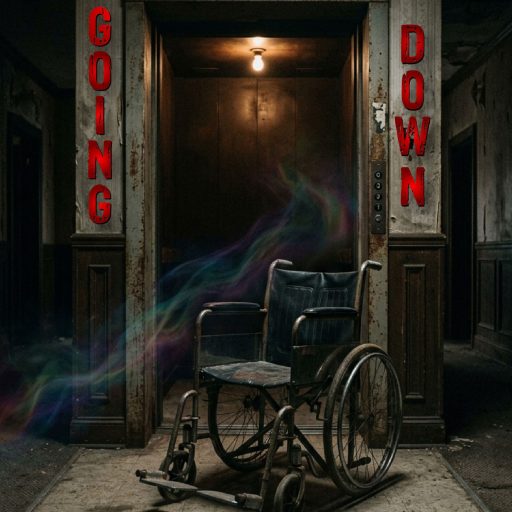
These experiences, my time in the military and being a DM, are the biggest influences for Going Down. The military taught me about tension and the way fear builds slowly. DM’ing taught me to trust chaos and let characters be unpredictable.
Izzy has been running from fear for over a decade. She’s dealt with an unimaginable amount of loss since she was a teenager. That’s what fuels her to become the person she is today. It’s what fuels the decisions she makes throughout the course of this story. Her dad gets onto an elevator, something she fears more than anything else in this world. A fear so primal that it’s become embedded into her DNA. And yet, she climbs on with him because for her, there was never another option. There always comes a time when you’re put to the test. Face the fear head-on or continue to run away. She chooses to face it, and the elevator almost makes it without issue. But then it falls to a floor that’s not supposed to exist.
The story is about what happens when the choice to stay or run is made for you. When every exit is blocked, and the right answer isn’t obvious because there is no right answer. You’re forced to figure out how to survive anyway. I wrote it because I wanted to bring to life that anxiety and fear that’s essential to horror. I wanted to have characters that were smart and made the best choices they could in a terrible situation. To see how they’d find their way through when everything was pit against them. Not only the external obstacles but the internal ones as well. On the flip side, I wanted to show how far we as humans can go to help and protect each other.
While I do dabble in other genres, I always find my way back to horror. I don’t have a great answer as to why besides that it’s what comes naturally to me. We’re intrinsically entwined and I wouldn’t have it any other way, to be honest.
— Blue Thalman Best